
Responsive website / Two-player games / Long-distance relationships
Twofold: a game room for couples living in different time zones
Overview
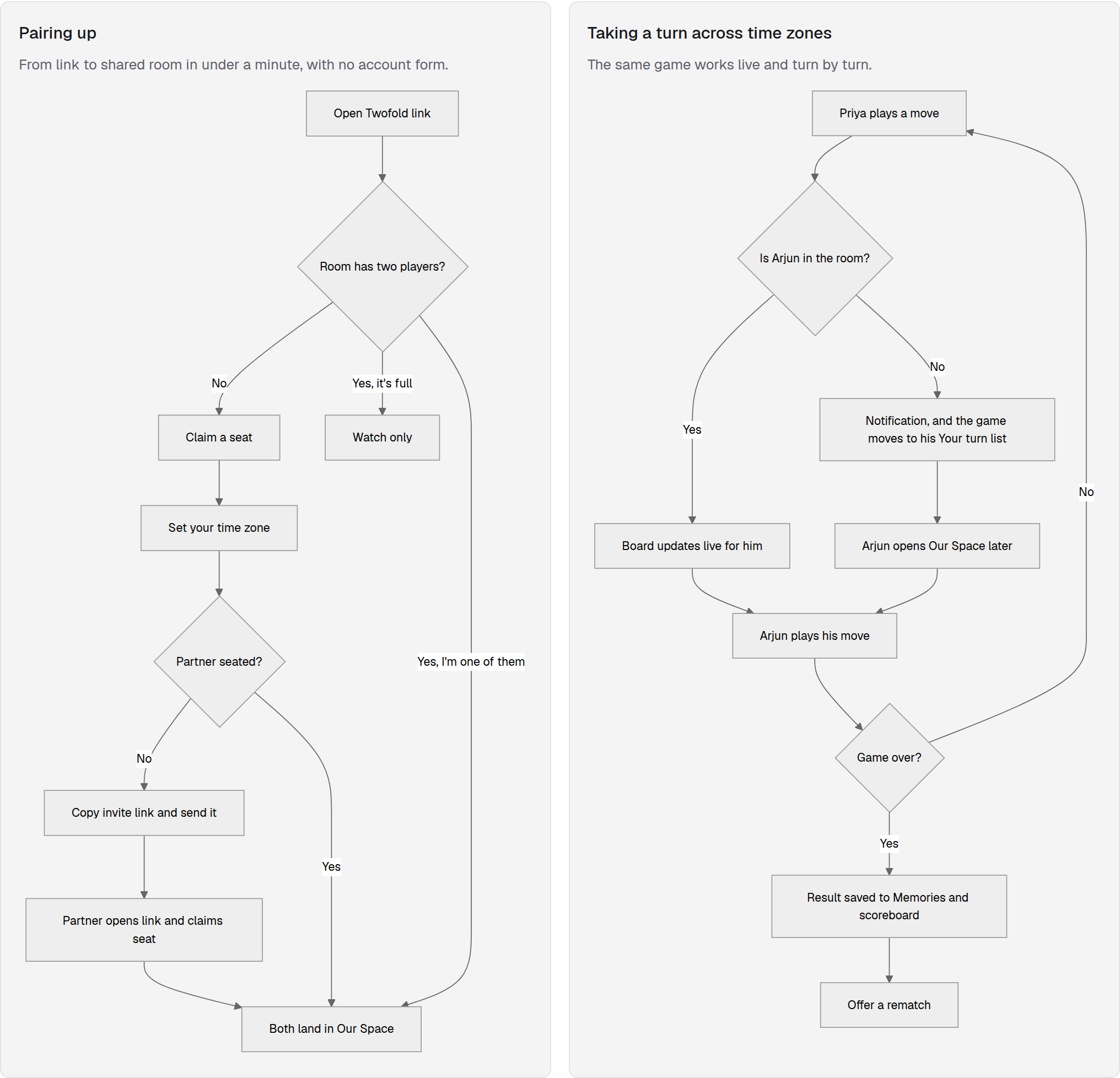
Twofold lets long-distance couples play games together. You play live when your free hours overlap, and take turns when they don't, so a game started on a video call can be finished across two days and a 9-hour time difference.
Play the prototype →- Role
- UX Designer & Researcher
- Project type
- Concept project
- Duration
- 1-week sprint
- Deliverables
- Research, personas, IA, brand, working website prototype
Background
Long-distance couples spend a lot of their time together on calls and in text threads. Over months, those conversations drift toward logistics: flights, schedules, recaps of the day. What partners miss is the low-stakes, playful time that happens naturally when you share a couch.
Games fit that kind of time well, but existing options split in two. Couple apps are built around questions and self-improvement. Multiplayer game apps are built for friend groups and assume both players are online at once.
The problem
“By the time I’m free, he’s asleep. I want something he can pick up when he wakes up.”
The solution
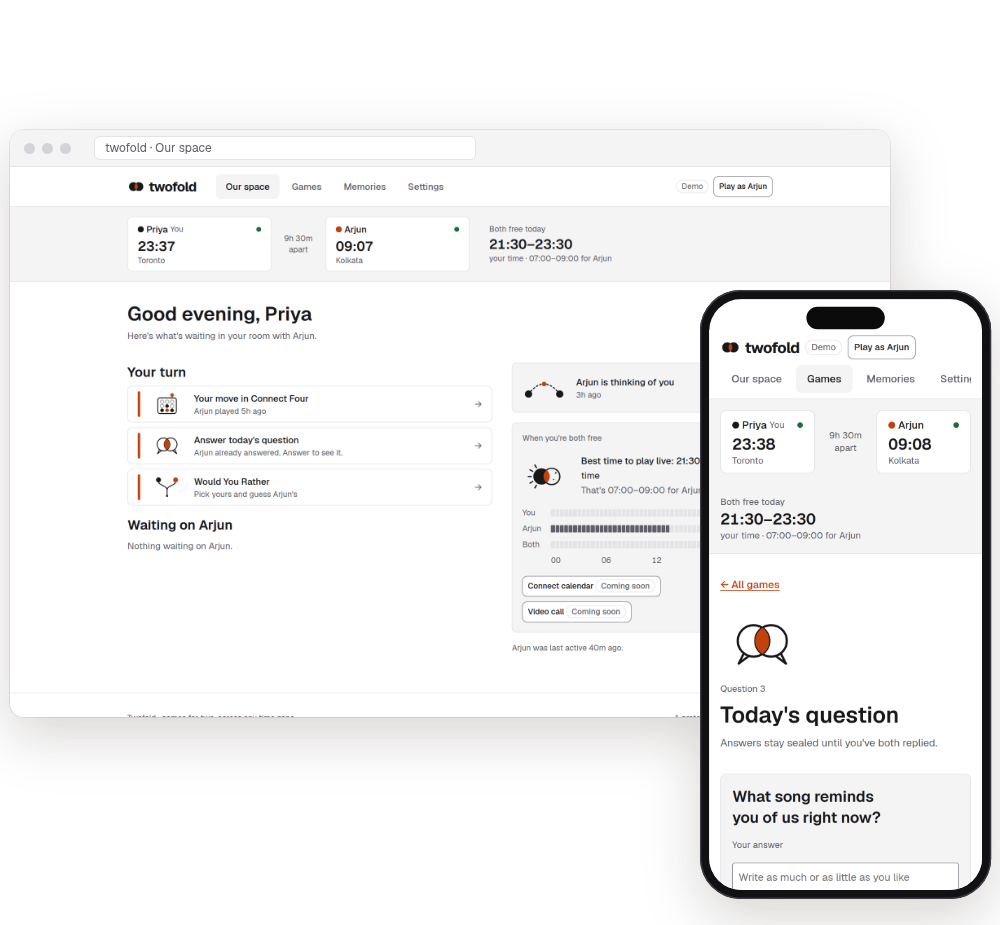
Twofold is one private room on the web, shared by two people. Every game saves its state, so moves sync instantly when you’re both there and wait in your partner’s “Your turn” list when you’re not. Both local times sit side by side, an overlap finder shows when you’re both free, and every finished game is kept in Memories.
How might we
“How might we help partners in different time zones play together every day, whether or not they’re online at the same time?”
User research
I reviewed peer-reviewed relationship research, a 2025 HCI study of 13 long-distance couples who play games weekly (ACM DIS ’25), and public listings and reviews of the main couple and multiplayer apps. Long-distance couples report satisfaction equal to close couples, and interact less often but disclose more when they do.
- Live play is the exception: with big time differences, couples share a short window. Turn-based play has to be the default.
- A gap between talk apps and game apps: couple apps are question-led; game apps treat a partner like any friend.
- Couples play differently: co-op, balanced and competitive couples all exist, so the product needs both kinds of games.
- A game becomes a memory: finished games are small pieces of relationship history worth keeping.
- Setup friction kills spontaneity: joining by link, with no account form, is what people praise most.
- Small signals count: a one-tap “thinking of you” gives presence without a conversation.
This sprint used secondary research, so the personas are proto-personas. An interview guide and usability test plan are ready to validate them with real couples.

Competitive analysis
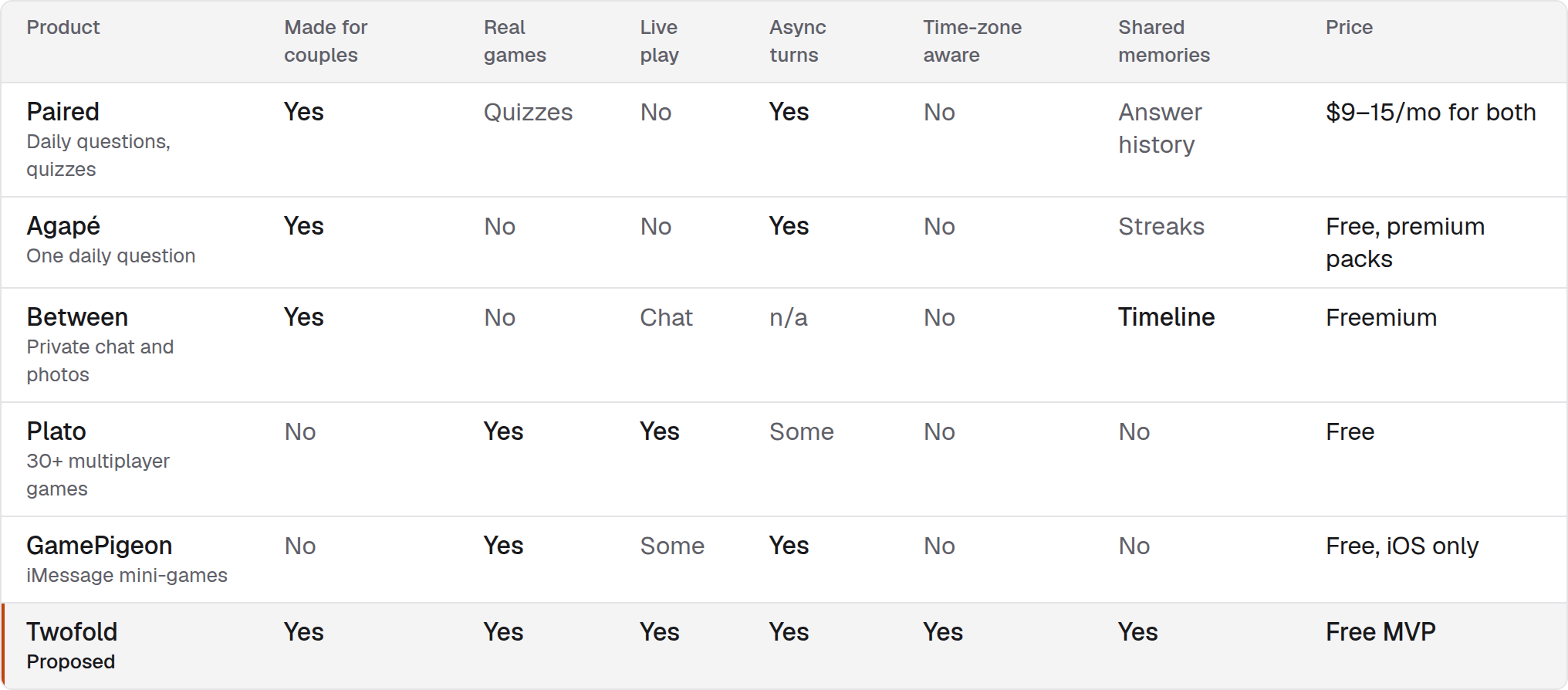
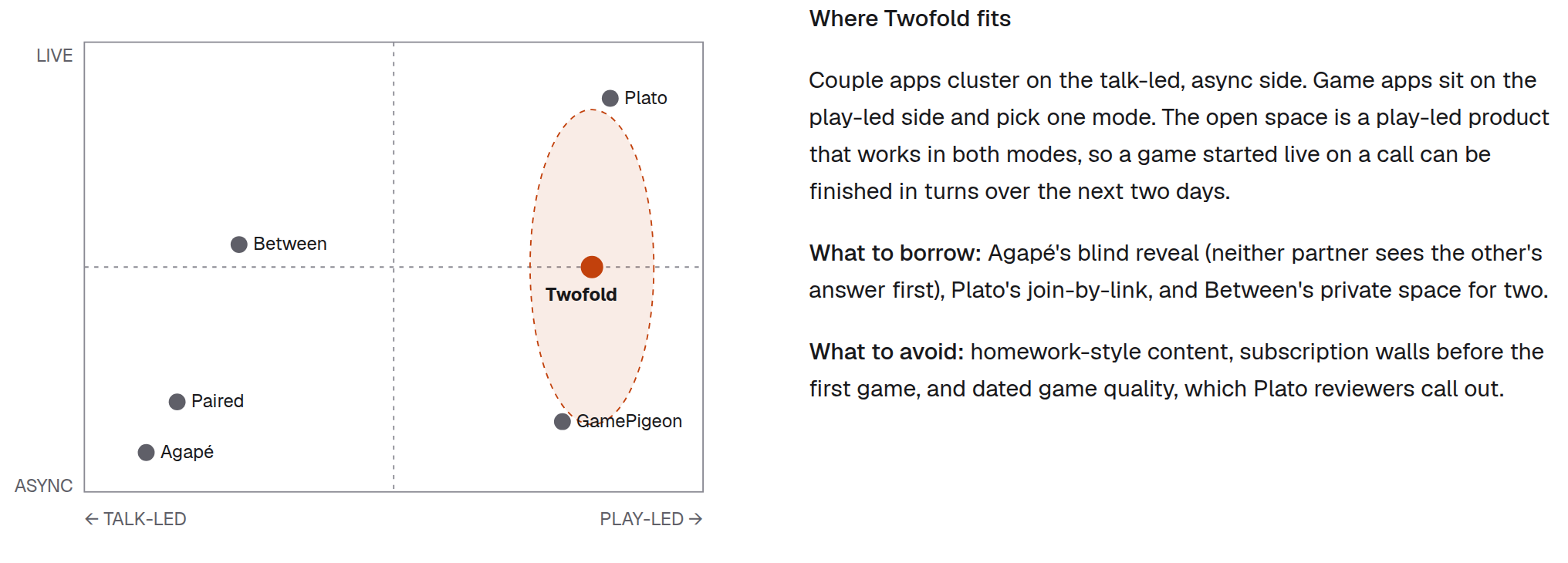
I compared five products long-distance couples already use. Couple apps cluster on the talk-led, async side; game apps are play-led but pick one mode. The open space is a play-led product that works both live and turn by turn.
Design approach
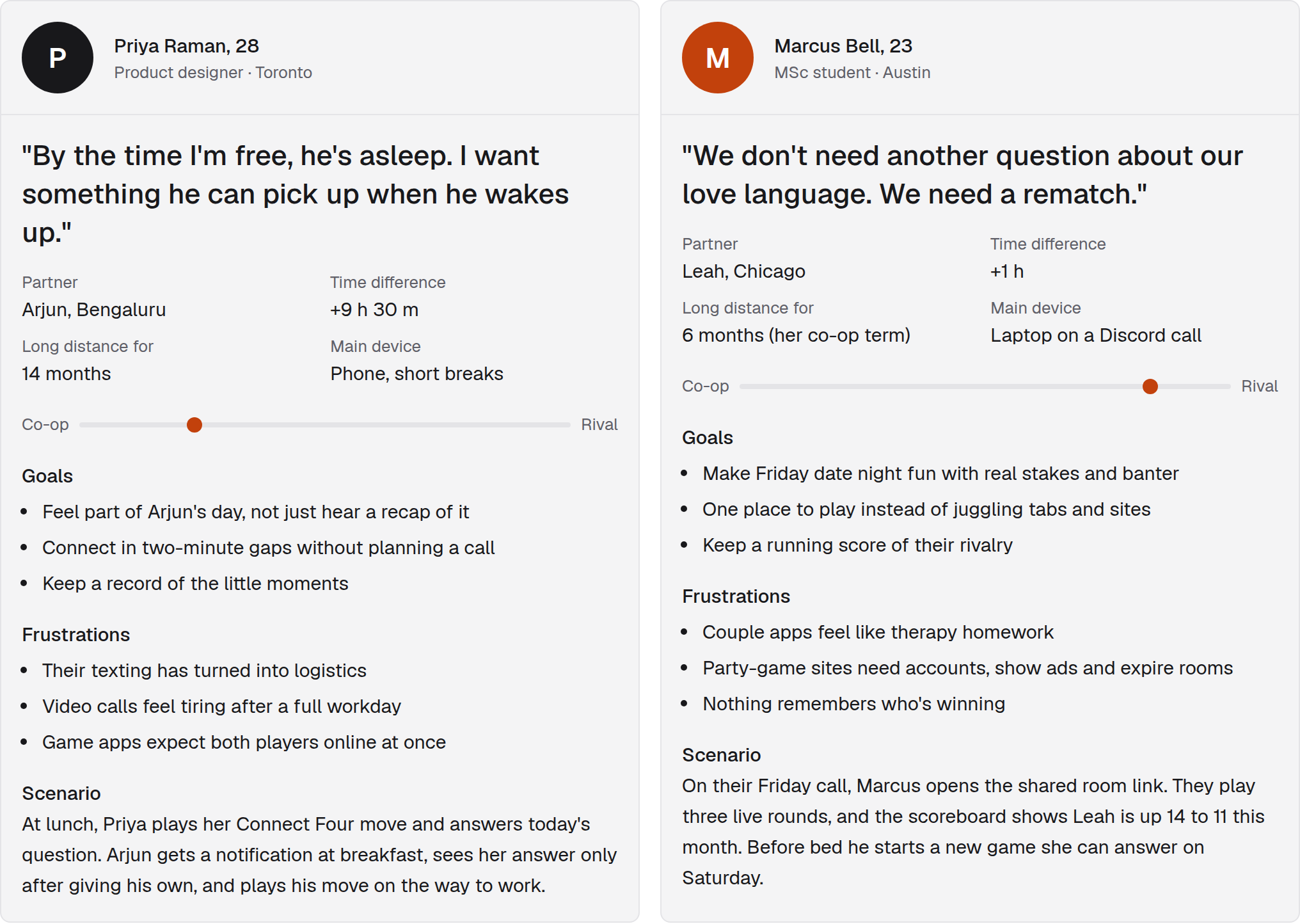
Two proto-personas cover the ends of the range: a large time difference with a cooperative style, and a small one with a competitive style.
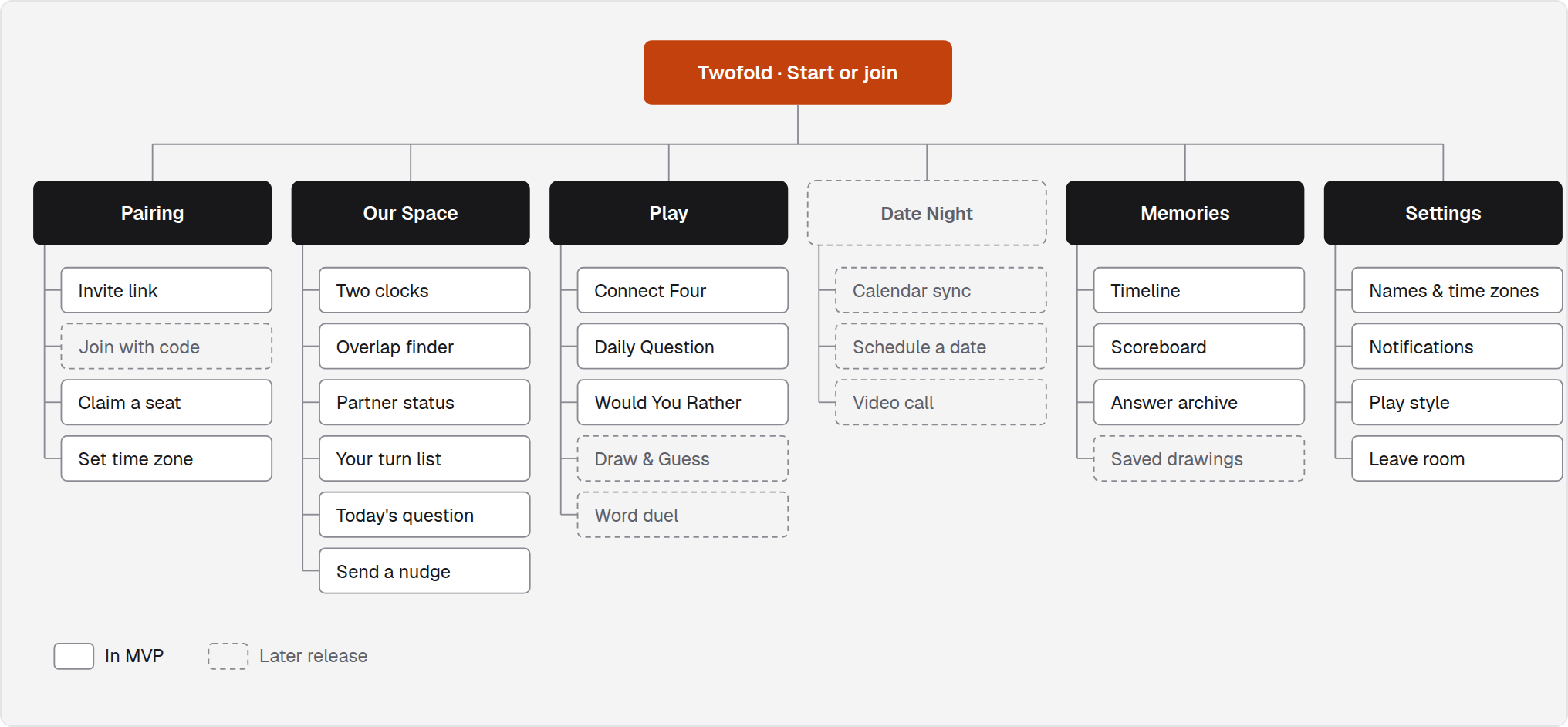
The app is one private space for two, so the structure stays shallow: every main area is one tap from home.
Scope and design decisions
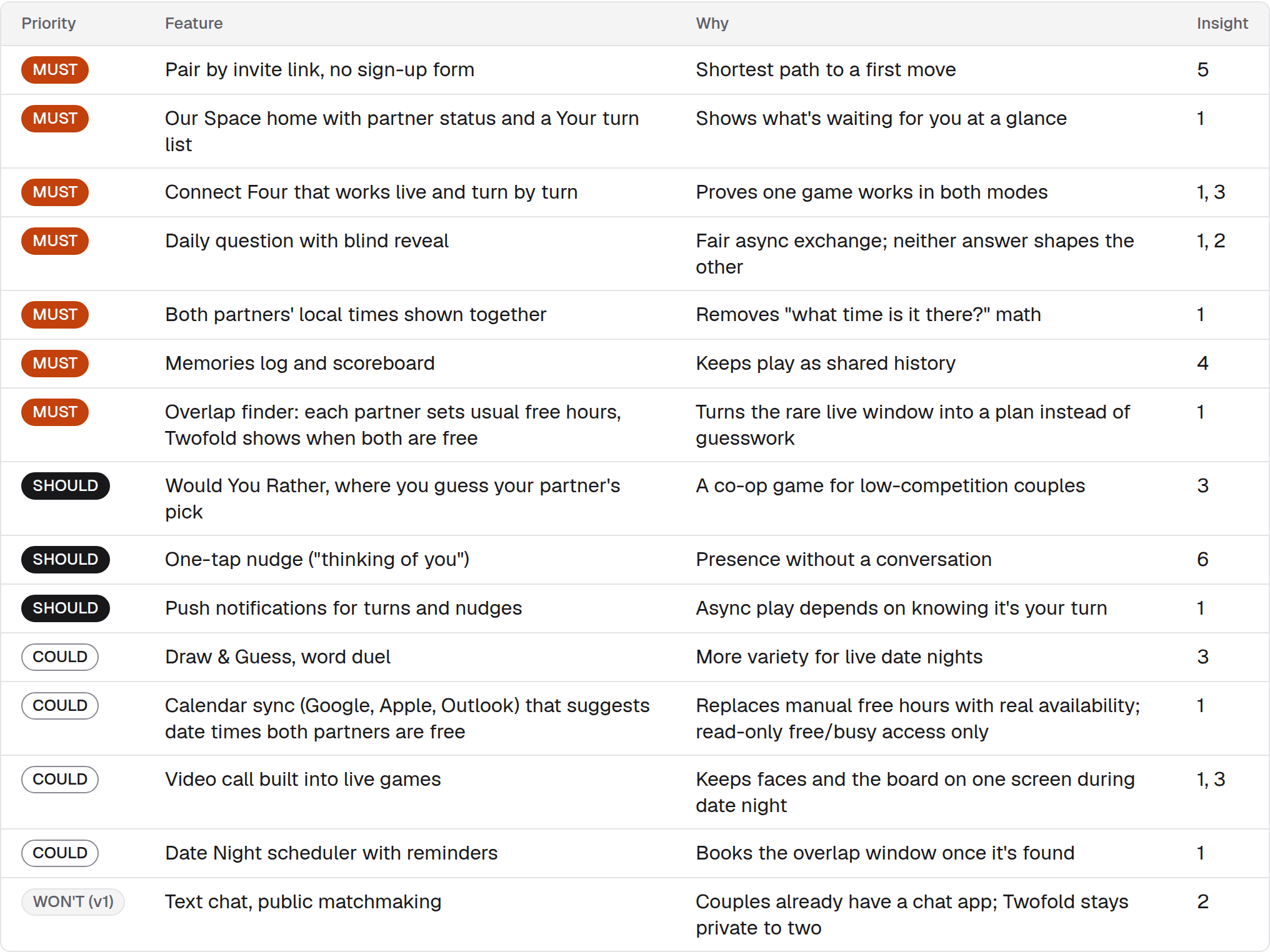
I sorted features with MoSCoW, keeping the MVP to what tests the main idea: can a couple keep a game going across a large time difference?
- Async first, live as a bonus: every game is a saved state that syncs live when both partners are in the room.
- Blind reveal: your partner’s answer stays hidden until you’ve written yours.
- One room, two seats: the link is the room; no usernames or friend lists.
- Two clocks and the overlap: both local times and a 24-hour free-time strip, so no one does time-zone maths.
Brand identity
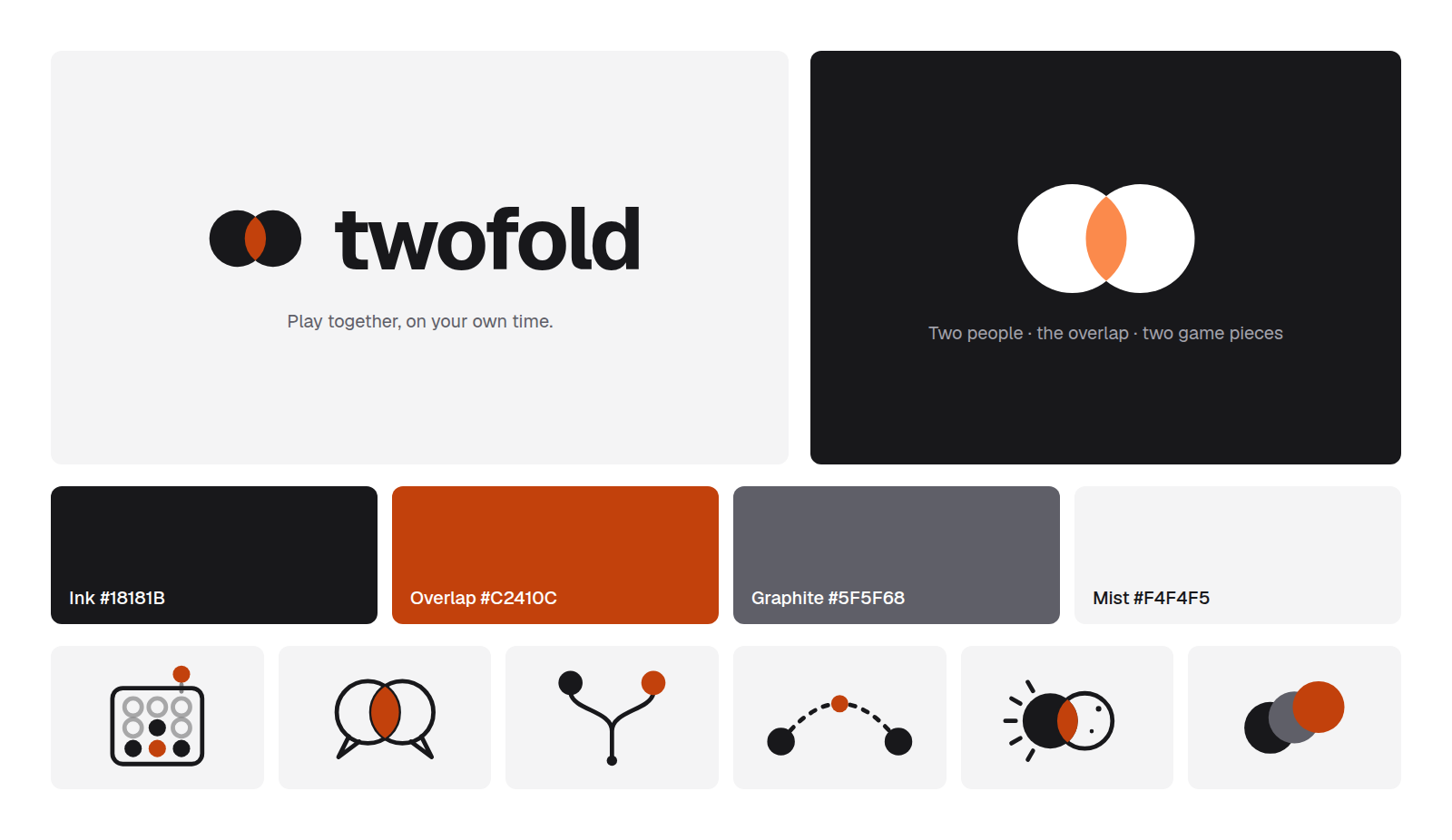
The research gave the brand its idea. Couples live two separate days that overlap for an hour or two, so the logo is two circles, one for each partner, with the shared time between them in a warm accent. The name says the same thing: two people, and two days folding over each other. The same parts make up a set of spot illustrations that sit beside each game.
Prototype
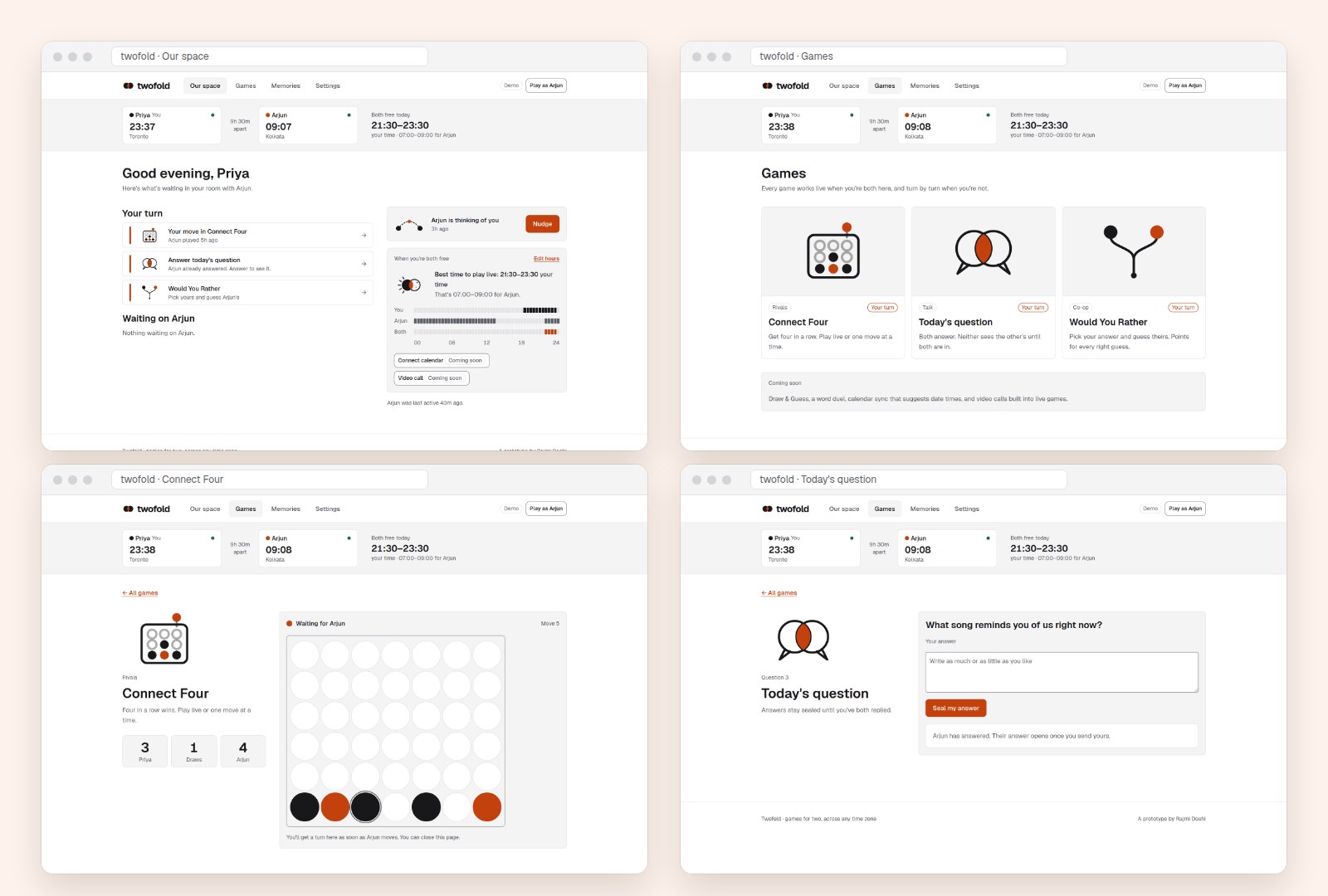
The prototype is a working two-player website: pairing, Our Space with two clocks and the overlap finder, Connect Four, a blind-reveal daily question, Would You Rather, nudges and Memories. It works on desktop and phone. The version here runs as a demo where you can switch between Priya and Arjun.
Next steps
Remote moderated usability sessions with 5 long-distance couples, each partner on their own device:
- Create a room and invite your partner.
- Play a Connect Four move while your partner is away.
- Find a time you’re both free to play live tonight.
- Answer today’s question and find your partner’s answer.
Calendar sync and video calls built into live games are planned for later releases.
Learnings
- Research reframes the brief: the hard part isn’t the game, it’s that two people are rarely free at once.
- Design for waiting: async states, sealed answers and nudges needed as much care as the games.
- Let the idea carry through: the overlap shaped the feature set, the logo and the illustrations.
- Be honest about evidence: secondary research gets you to proto-personas; real interviews come next.